What Is Coherent Summation?
When two loudspeakers emit the same signal, the sound pressure at any point in space is the vector sum of the complex pressure contributions from each source. At low frequencies, where the wavelength is much larger than the cabinet spacing, this summation is nearly uniform in all directions. But at high frequencies, where the wavelength approaches or is smaller than the cabinet spacing, the summation becomes highly directional — creating grating lobes.
Why Incoherent Models Produce the Wrong Answer
An incoherent summation model treats each cabinet as an independent energy source and sums acoustic intensities (pressure squared) rather than complex pressures. This is computationally simpler and works reasonably well at low frequencies, but it fundamentally cannot predict grating lobe behavior. At high frequencies, an incoherent model will show smooth, predictable coverage where the actual system produces sharp interference nulls and lobes.
An incoherent model is not just imprecise — it is categorically wrong above the frequency where cabinet spacing equals half a wavelength. The physics it is based on do not apply.
The Coherent Model in SINE Array Solver
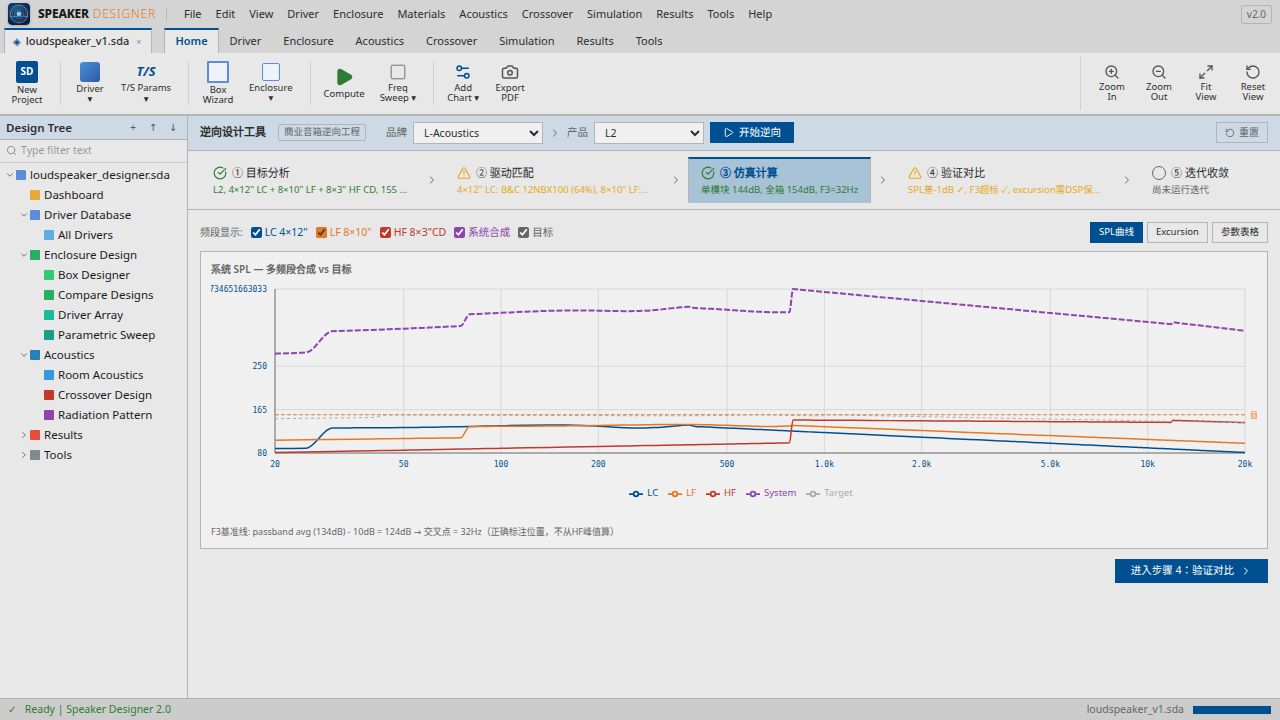
SINE Array Solver implements a fully coherent summation model. For each frequency band and each point in the prediction grid, it computes the complex pressure contribution from every cabinet in the array — accounting for distance, angle, cabinet directivity, and the phase response of any applied delays. The result is a far-field prediction that accurately captures grating lobe formation, mutual coupling effects, and the directivity narrowing that occurs as frequency rises.
Practical Implications for System Design
- Grating lobe onset frequency can be predicted and pushed higher by reducing inter-cabinet splay
- High-frequency coverage narrowing is predictable and can be compensated with HF-only delay tapering
- Mutual coupling at low frequencies increases sensitivity — incoherent models underestimate this by up to 6 dB
- Coherent models reveal coverage holes that incoherent models report as uniformly covered zones